Home Blog

NUCLEIC ACIDS – LIFE SCIENCES QUESTIONS AND ANSWERS

NUCLEIC ACIDS – LIFE SCIENCES QUESTIONS AND ANSWERS Nucleic acids are the unsung heroes of life sciences, the molecular architects of all living organisms. From the blueprint of our genetic code to the orchestration of cellular processes, these molecules hold the key to understanding life itself. In this blog post, we delve into the intricacies of nucleic acids, exploring some common questions and providing insightful answers to deepen our understanding of these remarkable molecules.

Activity 1

  1. A DNA molecule contains 600 nitrogen bases. If 20% of this is adenine, determine the number of each nitrogen base in the DNA molecule. (3)
  2. Figure 1.4 (below) represents part of a nucleic acid molecule. Study the diagram and answer the questions that follow.
    2.1 Identify the nucleic acid shown in Figure 1.4.  (1)
    2.2 Label the following: (drawing below)

    1. Part 1  (1)
    2. Part 2    (1)
    3. The nitrogenous bases 4, 5 and 6   (3)
      2.3 What is the collective name for the parts numbered 1, 2 and 3?(1)
  3. Questions 3.1 and 3.2 are based on Figure 1.5 (below). This is a diagrammatic representation of a part of two different nucleic acid molecules found in the cells of organisms during a stage in the process of protein synthesis.
    3.1 Name the molecules 1 and 2.  (2)
    3.2 Give a reason for your answer in question 3.1.  (2)
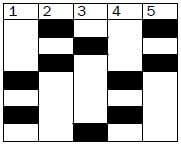
  4. The result of profiling various DNA samples in a criminal investigation is shown below
    nucleic acids 7   (Key below}
    4.1 Was suspect X or suspect Y involved in the crime?   (1)
    4.2 Does the DNA of the suspect (from answer 4.1) match the first or second sample? (2) [17]
 Key for question 4: Drawings for Q2 and Q3 above
  1. blood sample of victim
  2. blood sample of suspect X
  3. blood sample of suspect Y
  4. first sample of DNA from the crime scene
  5. second sample of DNA from crime scene
nucleic acids 6

Answers to activity 1

  1. 20% adenine = 20% thymine✔     30% cytosine✔= 30% guanine✔
    20  ×  600 = 120A = 120T               30 × 600 = 180C = 180G (3)
    100                                                 100
  2. 2.1 DNA✔
    2.2

    1. Phosphate✔ group (1)
    2. Deoxyribose✔sugar (1)
    3. 4 – adenine (A)✔
      6 – thymine✔
      5 – guanine (G)✔ (3)
      2.3 Nucleotide✔ (1)
  3. 3.1 1 – DNA     2 – mRNA/RNA✔ (2)
    3.2 DNA contains the nitrogenous base thymine (T).✔
    RNA contains the nitrogenous base uracil (U).✔ (2)
  4. 4.1 Suspect X was involved. ✔(1)
    4.2 The DNA of suspect X matches with the second sample. ✔✔ (2) [17]
  • cid.

Activity 2

Question 1
Study Figure 1.7 (below), which shows the process of protein synthesis, and answer the questions.
nucleic acids 9

Figure 1.7 Protein synthesis

1.1 Label structures A, B and D. (3)
1.2 State ONE function of molecule D. (1)
1.3 Which stage of protein synthesis takes place at F? (1)
1.4 Identify organelle C. (1)
1.5 Name and describe the stage of protein synthesis that takes place at organelle C. (7)
1.6 Write down the codon of anticodon E from top to bottom. (1)

1.7 Name the type of bond (labelled G) between the amino acids. (1) [15]

Answers to question 1

1.1
A – Nuclear membrane✔
B – mRNA✔
D – DNA✔ (3)

1.2 Carrying hereditary characteristics from parents to their offspring✔ OR Controls the synthesis (manufacturing) of proteins✔ (1)
1.3 Transcription✔ (1)
1.4 Ribosome✔ (1)
1.5 Translation✔

  • The mRNA strand from the nucleus becomes attached✔to a ribosome with its codons exposed
  • each tRNA molecule carrying a specific amino acid✔
  • according to its anticodon✔
  • matches up with/complements the codon of the mRNA✔
  • so that the amino acids are placed in the correct sequence✔
  • adjacent amino acids are linked✔
  • to form a protein✔ (7)

1.6 CAC✔ (the anticodon is GUG, so the complementary codon is CAC) (1)
1.7 Peptide Bond (1) [15]

Question 2
Table 1.3 below shows the DNA base triplets that code for different amino acids.

Amino acid Base triplet in DNA template
Leu (leucine) GAA
His (histidine) GTA
Lys (lysine) TTT
Pro (proline) GGG
Ala (alanine) CGA
Trp (tryptophan) ACC
Phe (phenylalanine) AAA
Gly (glycine) CCT

Table 1.3 Different amino acids and their DNA base triplets
The following is a part of a sequence of amino acids that forms a particular protein molecule:

Ala His Trp Leu Lys

2.1 Name the process by which mRNA is formed from a DNA   template. (1)
2.2 How many mRNA codons would be involved in forming the portion of protein shown above?  (1)
2.3 Write down the sequence of the first three mRNA codons (from left to right) for this portion of the protein.   (3) [5]

Answers to question 2

2.1 Transcription✔   (1)
2.2 5✔   (1)
2.3 GCU✔- CAU✔- UGG✔ (3) [5]

APPENDIX 2: EXEMPLAR EXAM PAPER GRADE 12 NOTES – LIFE SCIENCES STUDY GUIDES

APPENDIX 2: EXEMPLAR EXAM PAPER GRADE 12 NOTES – LIFE SCIENCES STUDY GUIDES Appendix 2 is a curated collection of exemplar exam papers and accompanying notes designed specifically for Grade 12 students tackling Life Sciences. These study guides are meticulously crafted by experts in the field, incorporating key concepts, critical thinking questions, and illustrative diagrams to aid comprehension and retention of essential information. They offer a comprehensive overview of the syllabus, providing students with a roadmap to navigate through complex topics with confidence.

LIFE SCIENCES
STUDY GUIDES AND NOTES
GRADE 12

Appendix 2: Exemplar exam paper

The 2014 Life Sciences exams have a new format in line with CAPS. The Department of Basic Education has offered an example of Life Sciences Paper 1 and Paper 2 with marking memoranda.
Use these exam papers and memoranda to help you prepare for your exams:

  1. Answer the questions in Life Sciences Paper 1. Make sure you take a break before doing the same with Paper 2. Treat them as “real” exams by preparing yourself as if these were real exams, so have the paper, pens, pencils, eraser and other materials that you need. Time yourself so you complete each paper within the 2 ½ hours that is
    allocated to them. This exercise is meant to test your own knowledge – so don’t cheat yourself by looking up the answers in the memo before you’ve finished each exam.
  2. Use the memoranda to check whether or not your answers are correct. Note where you have got answers wrong – these are the sections of the curriculum that you need to do more work on. Go back to your textbooks and to the relevant sections of this study guide, and spend time learning the sections for which you got the lowest marks.

Paper 1
QUESTIONS

INSTRUCTIONS AND INFORMATION
Read the following instructions carefully before answering the questions.

  1. Answer ALL the questions.
  2. Write ALL the answers in the ANSWER BOOK.
  3. Start the answers to EACH question at the top of a NEW page.
  4. Number the answers correctly according to the numbering system used in this question paper.
  5. Present your answers according to the instructions of each question.
  6. Do ALL drawings in pencil and label them in blue or black ink.
  7. Draw diagrams or flow charts only when asked to do so.
  8. The diagrams in this question paper are NOT necessarily drawn to scale.
  9. Do NOT use graph paper.
  10. You must use a non-programmable calculator, protractor and a compass, where necessary.
  11. Write neatly and legibly.

SECTION A
QUESTION 1
1.1 Various options are provided as possible answers to the following questions. Choose the correct answer and write only the letter (A to D) next to the question number (1.1.1 to 1.1.9) in the ANSWER BOOK, for example  1.1.10 D.
QUESTIONS 1.1.1 AND 1.1.2 REFER TO THE DIAGRAM BELOW SHOWING THE STRUCTURE OF THE HUMAN EAR.
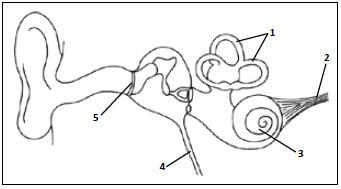
appendix 2 ear
1.1.1 Which part sends vibrations to the ossicles?

A 3
B 1
C 4
D 5

1.1.2 Which part maintains equal pressure on either side of the tympanic membrane?

A 4
B 3
C 2
D 1

1.1.3 Below is a set of events following fertilisation in humans.

1. The embryo is embedded in the uterine wall in humans.
2. A zygote is formed in the Fallopian tube.
3. Cell division occurs to form a ball of several hundred cells.
4. The blastocyst remains free for several days in the uterus.

Which ONE of the following represents the correct order in which the above events occur?

A 2, 3, 4, 1
B 2, 1, 3, 4
C 3, 2, 4, 1
D 1, 3, 2, 4

1.1.4 The following are effects of the secretion of different hormones:

1. An increase in the blood glucose level
2. An increase in the heart rate
3. An increase in the amount of digestive enzymes
4. An increase in blood flow to the skeletal muscles

Which ONE of the following combinations of the above effects is due to adrenalin?

A 1, 3 and 4
B 2, 3 and 4
C 1, 2 and 4
D 1, 2, 3 and 4

1.1.5 The control centre in the body that will be activated when an athlete is dehydrated is the …

A cerebellum.
B cerebrum.
C corpus callosum.
D pituitary gland.

1.1.6 The following blood vessels carry blood to or from the placenta in humans:

1. Mother’s artery
2. Mother’s vein
3. Umbilical artery
4. Umbilical vein

Which blood vessels contain blood with a larger amount of oxygen and nutrients?

A 1 and 3 as compared to 2 and 4
B 1 and 4 as compared to 2 and 3
C 2 and 3 as compared to 1 and 4
D 2 and 4 as compared to 1 and 3

1.1.7 Which ONE of the following is an advantage of the testes being held in the scrotum, outside the body cavity?

A More sperm can be stored in the scrotum.
B Sperm formation is more efficient at temperatures below the normal body temperature.
C The testes are better protected in the scrotum than in the body cavity.
D There is more time for prostate secretions to be added to the sperm.

1.1.8 Meiosis in a diploid cell results in …

A four identical gametes.
B four haploid gametes.
C two different diploid gametes.
D four gametes having the same chromosome number as the parent cell.

1.1.9 The list below gives some of the stages involved in gamete and zygote formation.

1. Prophase I
2. Prophase II
3. Metaphase I
4. Fertilisation

Which ONE of the following combinations of the above stages contributes to genetic variation?

A 1, 2 and 3
B 1, 3 and 4
C 2 and 3
D 3 and 4 (9 x 2) [18]

1.2 Give the correct biological term for each of the following descriptions. Write only the term next to the question number (1.2.1 to 1.2.9) in the ANSWER BOOK.
1.2.1 The period of development of an embryo in the uterus between fertilisation and birth
1.2.2 Disease characterised by a lack of insulin production
1.2.3 Tube that connects the pharynx and the middle ear
1.2.4 A process by which nutrients become highly concentrated in a body of water, leading to increased growth of organisms such as algae
1.2.5 A stage in the development of humans in which the embryo consists of a layer of cells surrounding a cavity
1.2.6 The structure at the tip of a sperm cell containing enzymes and which makes contact with the egg cell during fertilisation
1.2.7 The gland in the male reproductive system of humans that produces an alkaline fluid to counteract the acid environment of the vagina
1.2.8 The duct leading from the testis to the urethra in human males
1.2.9 The process by which the ovum is formed through meiosis in the ovary (9 x 1) (9)
1.3 Indicate whether each of the statements in COLUMN I applies to A only, 1.4 The diagram below represents a portion of the central nervous system of B only, both A and B or none of the items in COLUMN II. Write A only, humans. B only, both A and B, or none next to the question number (1.3.1 to 1.3.6) in the ANSWER BOOK.

COLUMN I COLUMN 11 
1.3.1 Type of development resulting in offspring that are capable of moving around after hatching A Precocial
B Altricial
1.3.2 Converts glucose to glycogen A Glucagon
B Adrenalin
1.3.3. Factors affecting water availability A Destruction of wetlands
B Poor farming practices
1.3.4 Provides greater chances for the fusion of sperm and egg A External fertilization
B Internal  fertilization
1.3.5 Characteristics of vivipary A Placenta is formed
B Live offspring is born
1.3.6 Examples of greenhouse gases A Carbon dioxide
B Methane

1.4 The diagram below represents a portion of the central nervous system of humans.
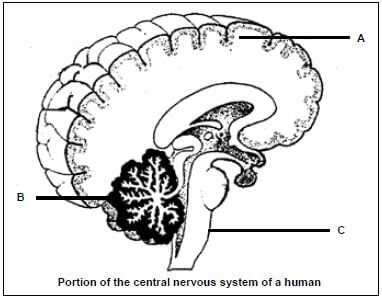
appendix 2 human brain
Write down the LETTER ONLY of the part which:
1.4.1 Regulates heartbeat and breathing rate (1)
1.4.2 Coordinates movement while walking (1)
1.4.3 Interprets what you see (1)
1.4.4 Has its hemispheres connected by the corpus callosum (1)
1.4.5 Controls balance and equilibrium (1) (5)
1.5  The diagram below shows the various stages in the life cycle of a human.
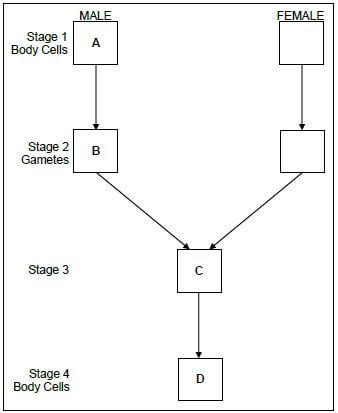
appendix 3 miosis male female
1.5.1 State the chromosome number of the cells represented by A, B and C. (3)
1.5.2 Name the structure at Stage 3. (1)
1.5.3 Between which two consecutive stages does meiosis occur in the life cycle? (1)
1.5.4 Between which two consecutive stages does mitosis occur in the life cycle? (1) (6)

TOTAL SECTION A: 50

SECTION B
QUESTION 2
2.1 Study the diagram below, which shows a reflex arc.
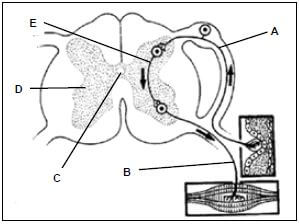
appendix 4 reflex arc
2.1.1 Give labels for each of the following:
(a) Region D (1)
(b) Neuron E (1)
2.1.2 Write down the LETTER of the part which:
(a) Transmits impulses to the central nervous system (1)
(b) Contains cerebrospinal fluid  (1)
2.1.3 Explain the effect on the reflex action if part B was damaged.   (2)
2.1.4  The nerve pathway in the above response is about 1,5 metres in length. A nerve impulse travels at 75 m s-1
Use this information to calculate the time taken for this reflex action to occur. Show all working.  (3)
2.1.5 Explain the significance of a reflex action.  (2) [11]
2.2 A learner carried out an investigation to measure the reaction time of two people (A and B). Each person had to ring a bell when a light flashed on. The time taken for each person to react was recorded and plotted on the bar graph below. The test was carried out 10 times.
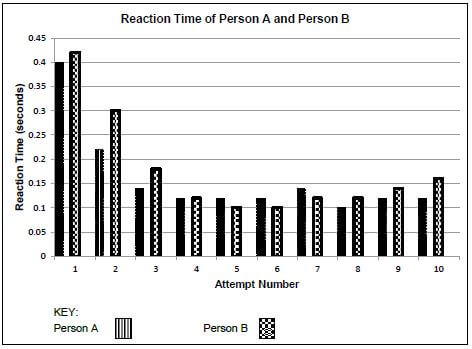
appendix 5 reaction time
2.2.1 What was the slowest reaction time? (1)
2.2.2 Describe how the reaction time of Person B changed over the 10 attempts. (3)
2.2.3 Suggest a possible reason for the trend described in QUESTION 2.2.2. (2)
2.2.4 What was the stimulus in this investigation? (1)
2.2.5 How would the reaction time of Person A have differed if he/she had been under the influence of drugs during the experiment? (1) (8)
2.3 The diagram shows two eyes (X and Y) focused on objects (represented by arrows) at different distances from the eye. Objects A and C were 2 metres away from the eye. Objects B and D were 7 metres away from the eye
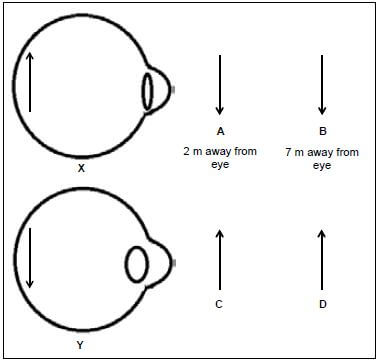
appendix 6 eyes kjhkj
2.3.1 Write down the LETTER ONLY of the object that:
(a) Eye X is focused on (2)
(b) Eye Y is focused on (2)
2.3.2 Name and describe the process that allows eye Y to form a clear image on the retina. (5) (9)
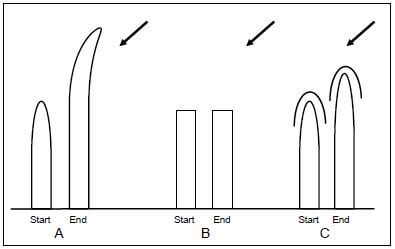
2.4 A Grade 12 learner performed an investigation to determine the effect of light on the growth of plant shoots. The learner divided the plants that were used into three groups as follows:

Group A – The tip of the shoot was intact.
Group B – The tip of the shoot was removed.
Group C – The tip of the shoot was covered by a cap that does not allow light to pass through.

The diagram below shows each shoot at the start of the investigation and next to each, the same shoot at the end of the investigation.
The arrows indicate the direction of light in each investigation.
appendix 7 germination
2.4.1 Name the dependent variable in this investigation.(1)
2.4.2 State TWO factors that must be kept constant in this investigation. (2)
2.4.3 The influence of which plant hormone is being investigated?(1)
2.4.4 Explain the results observed in investigations A and C, as illustrated in the diagram above. (6)
2.4.5 State TWO ways in which the learner could improve the reliability of this investigation. (2) (12) [40]

QUESTION 3
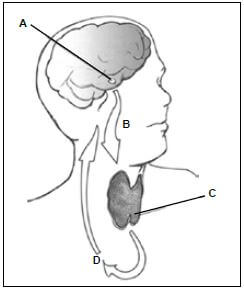
3.1 The diagram below represents the interaction between two important endocrine glands. The gland labelled A is found at the base of the brain, while the gland labelled C is present towards the front of the neck.
appendix 8 human head
3.1.1 Give a label for gland A. (1)
3.1.2 Name hormone B. (1)
3.1.3 State TWO functions of hormone D. (2)
(1) 3.1.4 Describe the negative feedback mechanism that operates when the level of hormone D is higher than normal in the blood. (5)(9)
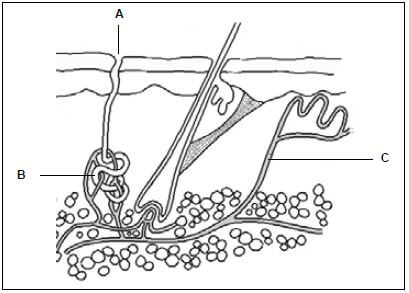
3.2 The diagram below shows a section through the mammalian skin.
appendix 9 skin
3.2.1 Give labels for parts A, B and C. (3)
3.2.2 Describe how parts B and C play a role in reducing the body temperature back to normal when it increases above the normal level. (6) (9)
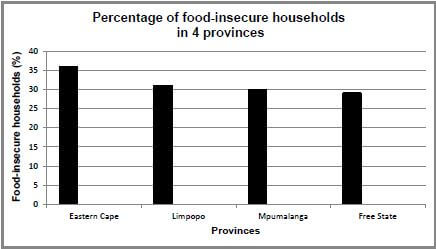
3.3 The Human Sciences Research Council (HSRC) conducted a survey on food security across the provinces. The results showed that the overall percentage of food-secure households in South Africa is 45,6% as opposed to 48% in 2008.
The results, indicating the percentage of food-insecure households in each province according to the latest survey, are shown in the table below.

Province  Food-Insecure Households
Eastern Cape 36
Limpopo 31
Mpumalanga 30
Free State 29
KwaZulu-Natal 28
Northern Cape 21
Gauteng 19
Western Cape 16

3.3.1 What is meant by food security? (2)
3.3.2 Use the data in the table to draw a bar graph for the four provinces that have the highest percentage of food-insecure households. (7)
3.3.3 State how the use of fertilisers by farmers can:
(a) Increase food security for a country (1)
(b) Decrease food security for a country (1)
3.3.4 State how the use of pesticides by farmers can:
(a) Increase food security for a country (1)
(b) Decrease food security for a country (1)
3.3.5 State TWO factors, other than the use of fertilisers and pesticides, which may have led to a decrease in the percentage of food-secure households in South Africa since 2008. (2) (15)
3.4 The carbon dioxide concentration in the atmosphere was recorded at 400 parts per million (ppm) in May 2013 compared to 316 parts per million (ppm) in 1958. This change is due to an increase in the use of fossil fuels as well as an increase in deforestation.
3.4.1 Describe how deforestation contributes to the high carbon dioxide concentration in the atmosphere. (2)
3.4.2 State ONE other impact of deforestation on the environment. (1)
3.4.3 Explain why we should be concerned about the rising carbon dioxide levels. (3)
3.4.4 Suggest ONE way in which the government can reduce carbon emissions caused by the generation of electricity. (1) (7) [40]

TOTAL SECTION B: 80

SECTION C
QUESTION 4
Name the hormones produced by the testes and ovaries and describe the role of each hormone in human reproduction.

Content: (17)
Synthesis: (3)
(20)

NOTE: NO marks will be awarded for answers in the form of flow charts or diagrams.

TOTAL SECTION C: 20
GRAND TOTAL: 150

MEMORANDUM

PRINCIPLES RELATED TO MARKING LIFE SCIENCES

  1. If more information than marks allocated is given
    Stop marking when maximum marks is reached and put a wavy line and ‘max’ in the right-hand margin.
  2. If, for example, three reasons are required and five are given
    Mark the first three irrespective of whether all or some are correct/incorrect.
  3. If whole process is given when only a part of it is required
    Read all and credit the relevant part.
  4. If comparisons are asked for but descriptions are given
    Accept if the differences/similarities are clear.
  5. If tabulation is required but paragraphs are given
    Candidates will lose marks for not tabulating.
  6. If diagrams are given with annotations when descriptions are required
    Candidates will lose marks.
  7. If flow charts are given instead of descriptions
    Candidates will lose marks.
  8. If sequence is muddled and links do not make sense
    Where sequence and links are correct, credit. Where sequence and links are incorrect, do not credit. If sequence and links become correct again, resume credit.
  9. Non-recognised abbreviations
    Accept if first defined in answer. If not defined, do not credit the unrecognised abbreviation but credit the rest of the answer if correct.
  10. Wrong numbering
    If answer fits into the correct sequence of questions but the wrong number is given, it is acceptable.
  11. If language used changes the intended meaning
    Do not accept.
  12. Spelling errors
    If recognisable, accept the answer, provided it does not mean something else in Life Sciences or if it is out of context.
  13. If common names are given in terminology
    Accept, provided it was accepted at the national memo discussion meeting.
  14. If only the letter is asked for but only the name is given (and vice versa)
    Do not credit.
  15. If units are not given in measurements
    Candidates will lose marks. Memorandum will allocate marks for units separately.
  16. Be sensitive to the sense of an answer, which may be stated in a different way.
  17. Caption
    All illustrations (diagrams, graphs, tables, etc.) must have a caption.
  18. Code-switching of official languages (terms and concepts)
    A single word or two that appear(s) in any official language other than the learners’ assessment language used to the greatest extent in his/her answers should be credited if it is correct. A marker that is proficient in the relevant official language should be consulted. This is applicable to all official languages.
  19. Changes to the memorandum
    No changes must be made to the memoranda without consulting the provincial internal moderator who in turn will consult with the national internal moderator (and the Umalusi moderators where necessary).
  20. Official memoranda
    Only memoranda bearing the signatures of the national internal moderator and the Umalusi moderators and distributed by the National Department of Basic Education via the provinces must be used.

SECTION A
QUESTION 1
1.1
1.1.1 D✔✔
1.1.2 A✔✔
1.1.3 A✔✔
1.1.4 C✔✔
1.1.5 D✔✔
1.1.6 B✔✔
1.1.7 B✔✔
1.1.8 B✔✔
1.1.9 B✔✔ (9 x 2) (18)
1.2
1.2.1 Gestation✔
1.2.2 Diabetes mellitus✔
1.2.3 Eustachian✔ tube
1.2.4 Eutrophication✔
1.2.5 Blastocyst✔
1.2.6 Acrosome✔
1.2.7 Prostate✔
1.2.8 Sperm duct✔/vas deferens
1.2.9 Oogenesis✔ (9 x 1) (9)
1.3
1.3.1 A only ✔
1.3.2 None✔✔
1.3.3 Both A and B ✔✔
1.3.4 B only✔✔
1.3.5 Both A and B✔✔
1.3.6 Both A and B✔✔ (6 x 2) (12)
1.4
1.4.1 C✔ (1)
1.4.2 B✔ (1)
1.4.3 A✔ (1)
1.4.4 A✔ (1)
1.4.5 B✔ (1) (5)
1.5
1.5.1

A – 46✔
B – 23✔
C – 46✔ (3)

1.5.2 Zygote✔ (1)
1.5.3 Stages 1 and 2✔ (1)
1.5.4 Stages 3 and 4✔ (1) (6)

TOTAL SECTION A: 50

SECTION B
QUESTION 2
2.1
2.1.1

(a) Grey matter✔ (1)
(b) Interneuron✔/connector neuron (1)

2.1.2

(a) A✔ (1)
(b) C✔ (1)

2.1.3 Sensation would be felt✔ but there would be no response✔ (2)
2.1.4 1,5 m ÷ 75 m.s-1✔ = 0,02✔ s✔ (3)
2.1.5 Helps to protect the body✔by reacting quickly✔ (2) (11)
2.2
2.2.1 0,42 seconds✔ (1)
2.2.2

  • It decreased first✔
  • then levelled off✔
  • and finally increased again.✔ (3)

2.2.3 Practice makes reaction time faster✔ but later, tiredness slows down the reaction time.✔ (2)
2.2.4 Light✔(1)
2.2.5 Reaction time would probably increase✔ (1) (8)
2.3
2.3.1

(a) B✔✔ (2)
(b) C✔✔ (2)

2.3.2

  • Accommodation✔ (1)
  • Ciliary muscles contract✔
  • Suspensory ligaments slacken✔
  • Tension on lens decreases✔
  • Lens becomes more convex✔
  • Refractive power of lens increases✔
  • A clear image now forms on the retina (any 4) (5) (9)

2.4
2.4.1 Growth of plant shoots✔ (1)
2.4.2

  • Same environment in which the shoots are placed✔
  • Same type of shoot used✔
    (Mark first TWO only) (2)

2.4.3 Auxins✔ (1)
2.4.4 In investigation A:

  • Light from the right✔
  • caused auxins to move to shaded side of the shoot✔
  • leading to increased cell elongation and division✔
  • There was therefore greater growth on the shaded side✔
  • thus bending the shoot in the direction of the source of light✔ (any 4)

In investigation C:

  • Light has no influence on the distribution of auxins✔
  • therefore the shoot grew upright✔ (2) (6)

2.4.5

  • Repeat the investigation✔
  • Use more than one plant for each treatment✔
    (Mark first TWO only) (2) (12) [40]

QUESTION 3
3.1
3.1.1 Pituitary gland/hypophysis✔ (1)
3.1.2 B – TSH/thyroid-stimulating hormone✔ (1)
3.1.3

  • Controls metabolism✔
  • Influences heart rate✔
  • Influences functioning of central nervous system✔
    (Mark first TWO only) (any 2) (2)

3.1.4

  • High levels of thyroxin is detected✔by the hypophysis
  • which leads to a decrease✔
  • in the secretion of TSH✔
  • Activity of thyroid is slowed down✔ /less thyroxin produced
  • Thyroxin level drops✔ to normal (5)

3.2
3.2.1

A – Sweat pore✔
B – Sweat gland✔
C – Blood vessel✔ (3)

3.2.2

  • Impulses sent from hypothalamus✔to C (blood vessels)
  • Blood vessels dilate✔/vasodilation occurs
  • More blood carrying heat comes to the skin surface✔
  • and therefore more heat is lost from the body✔
  • B (Sweat glands) produce more sweat✔
  • When sweat evaporates from the skin surface ✔
  • More heat is lost from the skin✔
  • leading to a drop in the body temperature✔                   (any 3)      (6) (9)

3.3
3.3.1 Having access to enough foodon a daily basis, so as to ensure healthy living✔ (2)
3.3.2
appendix 10 provinces
Mark allocation for the graph 3.3.3

Criterion  Elaboration  Mark 
Type of graph Bar graph drawn  1
Data used Graph drawn for four provinces only (EC, LIM, MPU and FS)
Caption Includes both variables: ‘Provinces’ and ‘Percentage food-insecure households’.  1
X-axis Appropriate scale
AND
Correct label: Provinces
 1
Y-axis Appropriate scale
AND
Correct label and unit: Food-insecure households(%)
 1
Plotting of points 1-3 bars plotted correctly – 1 mark
All 4 bars plotted correctly – 2 marks
 2

3.3.3

(a) Fertilisers provide nutrients that increase crop growth✔
(b) Fertilisers are expensive – causes food prices to increase✔/ over-use of fertilisers can cause oxygen deprivation in soil which will eventually reduce crop production

3.3.4

(a) Pesticides ensure that pests do not cause large-scale damage to crops✔
(b) Pesticides could kill pests as well as their predators – hence more pesticides would have to be used, raising the cost of food✔

3.3.5

  • Massive unemployment in the country✔
  • Increase in the size of the human population✔
  • Farms destroyed for development✔
  • Decrease in subsistence farming ✔
  • Prolonged unfavourable environmental conditions✔
    (Mark first TWO only) (any 2 x 1)

3.4
3.4.1

  • There will be less trees✔
  • so less carbon dioxide will be used from the atmosphere for photosynthesis✔

3.4.2

  • Can lead to the loss of biodiversity✔/habitat destruction/soil erosion
    (Mark first ONE only)

3.4.3

  • Increased carbon dioxide levels lead to the enhanced greenhouse effect✔
  • which causes an increase in the global temperatures✔
  • This could lead to rise in sea levels because of melting ice✔/ floods/change in climate
  • which can lead to the extinction of some organisms✔. (any 3)

3.4.4 Use alternate sources of energy✔
(Mark first ONE only)

TOTAL SECTION B:

SECTION C
QUESTION 4
Testosterone✔

Produced by seminiferous tubules✔ in the testes
During puberty testosterone stimulates:

  • The deepening of the voice as vocal cords elongate in the larynx✔
  • The development of muscles✔
  • The growth of facial, pubic and body hair✔
  • Development of the penis and testes✔
  • The production of sperm in the testes✔ max (5)

Oestrogen✔
Produced by the Graafian follicles✔ in the ovaries

  • Causes the lining of the uterus✔/endometrium
  • to become thicker/more vascular ✔
  • in preparation for a possible implantation of the embryo and development of the foetus✔

During puberty oestrogen stimulates:

  • The widening of the pelvis/hips✔
  • The growth and development of the breasts✔
  • The growth of the female sex organs✔
  • The start of the menstrual cycle, ovulation and menstruation✔ max (7)

Progesterone✔
Produced by the corpus luteum✔ and placenta✔

  • Progesterone causes further thickening of the endometrium✔
  • so that it is ready for implantation of the embryo should fertilization occur✔
  • High levels of progesterone✔
  • inhibits the secretion of FSH✔
  • by the pituitary gland✔
  • which in turn prevents the further development of any new ovum in the ovary✔ max (5)

Content (17)
Synthesis (3)
(20)

ASSESSING THE PRESENTATION OF THE ESSAY

Criterion  Elaboration  Mark
Relevance No other hormone except testosterone, oestrogen and progesterone mentioned  1
Logical sequence Each hormone named is linked to its correct role  1
Comprehensive All three correct hormones mentioned at least three roles described for each hormone  1
 

MEIOSIS – LIFE SCIENCES QUESTIONS AND ANSWERS

MEIOSIS – LIFE SCIENCES QUESTIONS AND ANSWERS Meiosis, the process of cell division that leads to the formation of gametes, is a fundamental aspect of life sciences. Its intricate dance of chromosome segregation and genetic recombination is crucial for genetic diversity and the perpetuation of species. In this blog post, we delve into the fascinating world of meiosis, exploring common questions and providing comprehensive answers to deepen your understanding of this essential biological process.

What is Meiosis?

A simple definition of meiosis would be is this: meiosis is the process of cell division that results in the production of a haploid  “daughter” cell with a haploid chromosomal number of a diploid “parent” (“original”) cell. The resulting haploid cell after meiosis would have only one part of the various homologous chromosome pairs of the parent cell.

Biology definition

Meiosis is a form of cell division in sexually reproducing organisms wherein two consecutive nuclear divisions (meiosis I and meiosis II) occur without the chromosomal replication in between, leading to the production of four haploid gametes, each containing one of every pair of homologous chromosomes (that is, with the maternal and paternal chromosomes being distributed randomly between the cells). Etymology: from Greek meiōsis, meioun (to diminish), from meiōn (less).

Function of Meiosis

Why is meiosis important for organisms? Imagine this, if gametes (eggs and sperms) were to be produced by mitotic division only and not be meiosis, then the gametes would contain the same number of chromosomes as that of the diploid somatic cells. Consequently, when the gametes fuse during fertilization, the resulting zygote will contain four sets of the homologous chromosome and become tetraploid.

This scenario of “doubled chromosome content” will go on to the next generations and this leads to chromosomal aberrations. The chromosomal number is disrupted and unkept throughout generations. This is, in fact, a case of chromosomal abnormality. Therefore, to keep the number of chromosomes constant in each generation, gametes are produced by the process of meiosis, during the formation of gametes, meiotic cell division decreases the number of chromosomes to haploid.

So what does meiosis produce? Meiosis starts with one round of replication of chromosomal DNA, then two steps of nuclear division. As a result, four daughter nuclei (each of them is present in a new daughter cell) are produced from the meiotic division of the original cell. Each daughter cell nucleus contains only a haploid number of chromosomes. The formation of gametes haploid cells occurs in two rounds: Meiosis I and II, with DNA replication for one time only (at the S phase of interphase).

Meiosis vs. Mitosis

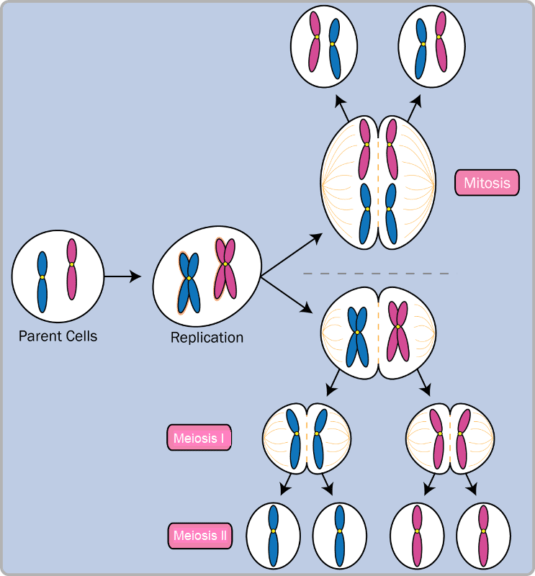
What is the difference between meiosis and mitosis? Meiosis and mitosis are the two main forms of cell division. The differences between them are summarized in Table 1.

Table 1: Main differences between meiosis and mitosis
Meiosis Mitosis
Produces haploid cells (n) Produces diploid cells (2n)
Includes two nuclear divisions Includes one nuclear division
The product is a gamete cell The product is a somatic cell
Responsible for sexual reproduction Responsible for asexual reproduction
Crossing over takes place No crossing over
Four cells are produced Two cells are produced


mitosis vs meiosis diagram

Phases of Meiosis

What is the process of meiosis? Meiosis is the process of four haploid cells formation from a parent diploid cell. The steps of meiosis include 2 stages: meiosis I and meiosis II. Meiosis 1 definition: the first stage in the meiotic division or the reduction division of the meiosis. This is because the number of chromosomes is reduced to half in this stage resulting in the formation of the haploid number of chromosomes.

Each pair of chromosomes come close together to exchange a part of their genetic material in a process or event called a synapse. This process occurs in the early meiosis 1 stages, particularly during prophase I.

During prophase 1 of meiosis I, the homologous pair of chromosomes come very close together and bind tightly to each other so that they almost act as one single unit. This unit is called a bivalent or a tetrad (indicating that each chromosome consists of two sister chromatids so the sum of bivalent is four chromatids). The bivalent splits into two parts after its alignment at the spindle equator so that each chromosome can move to the spindle pole at the opposite side. Consequently, each newly formed daughter nucleus after meiosis I is haploid since it has only one chromosome of the bivalent.

When do sister chromatids separate? Meiosis II which is the second stage of the meiosis cell cycle is somehow similar to mitosis where the two daughter cells are formed as a result of the separation of each two chromatids. Therefore, meiosis I is the stage at which events unique to the meiosis cycle occurs. Nevertheless, each stage of the meiotic division is subdivided in a manner that resembles the mitotic division, such as prophase, metaphase, anaphase, and telophase. However, the prophase of the first meiotic division is much more complicated and longer than the prophase of mitosis. In contrast, the prophase of the second meiotic division is simpler and shorter.

Activity 1

Question 1
Give the correct word or term for each of the statements or definitions provided below.

1.1 The structure that joins the two halves of a double-stranded chromosome  (1)
1.2 A pair of chromosomes, one inherited from each parent, that have the same genes at the same locus     (1)
1.3 A single-stranded chromosome formed during Anaphase 2    (1)
1.4 The point of contact between two chromosomes of a homologous pair during crossing over     (1)
1.5 One half of a double-stranded chromosome     (1)
1.6 The phase in meiosis where crossing over occurs  (1)

[6]

Answers to question 1
1.1 Centromere✔(1)
1.2 Homologous chromosomes✔ (1)
1.3 Daughter chromosome/chromatid✔ (1)
1.4 Chiasma✔/chiasmata✔ (1)
1.5 Chromatid✔ (1)
1.6 Prophase 1✔ (1) [6]

Question 2
Figure 2.12 (right) represents a process taking place during meiosis. Study the diagram and answer the questions that follow.
meiosis 13
2.1 Provide labels for parts A, B, C and D. (4)
2.2 Name the process in meiosis that is illustrated in Figure 2.12. (1)
2.3 State ONE importance of the process you named in question 2.2. (2)

2.4 Draw a diagram of the structure labelled A to show its appearance immediately after the process you named in question 2.2. (2) [9]

Answers to question 2
2.1

A – Chromosome✔
B – Centromere✔
C – Chromatid✔
D – Chiasma✔/chiasmata (4)

2.2 Crossing over✔ (1)
2.3 It introduces genetic✔ variation✔ (2)
2.4

  • A double-stranded chromosome with the strands joined by a centromere✔
  • There is evidence of crossing over.✔ (2)
    meiosis 14

Question 3
Figure 2.13 (below) represents an animal cell in a phase of meiosis. Study the diagram and answer the questions that follow.
meiosis 15
3.1 State whether the phase of meiosis shown in Figure 2.13 is meiosis I or meiosis II. (1)
3.2 Give ONE visible reason for your answer in question 3.1. (1)
3.3 Identify the parts labelled A and B. (2)
3.4 How many chromosomes:

  1. were present in the parent cell before meiosis began? (1)
  2. will be present in each cell at the end of meiosis? (1)

3.5 State ONE place in a human female where meiosis would take place. (1)
3.6 Could the cell represented in Figure 2.13 be that of a human? (1)
3.7 Explain your answer to question 3.6. (2)
3.8 Give TWO reasons why meiosis is biologically important. (2)
3.9 Give the term for the situation when some of the chromosomes do not separate correctly during the phase shown in Figure 2.13. (1) [13]

Answers to question 3
3.1 Meiosis II✔ (1)
3.2 Daughter chromosomes/chromatids are being pulled to the opposite poles✔ (1)
3.3

A – Spindle fibre✔
B – Cell membrane✔ (2)

3.4

a) 8✔
b) 4✔ (2)

3.5 Ovaries✔ (1)
3.6 No✔ (1)
3.7 There are only 4 chromosomes present3 instead of 23.✔ (2)
3.8

  • It introduces genetic variation.✔
  • It balances the doubling effect of fertilisation as it halves the number of chromosomes in the sex cells.✔ (2)

3.9 Non-disjunction✔ (1) [13]

Question 4
The diagram below shows the nuclei of the four cells that resulted from meiosis of chromosome pair 21 in a woman.
meiosis 16
Figure 2.14: Diagram that shows the nuclei of four cells resulted from meiosis
4.1 Explain why nucleus N does NOT have a chromosome pair 21. (2)

4.2 Name and explain the disorder that will result if diagram M represents an egg cell that fuses with a normal sperm cell. (3) [5]

Answers to question 4
4.1 During Anaphase 1 the chromosome pair 21 does not separate✔/ non-disjunction. Gamete M will have an extra copy of chromosome number 21 and therefore gamete N does not have a copy of chromosome 21✔ (2)
4.2 Down syndrome✔/Trisomy 21 if gamete M fuses with normal sperm having 1 copy of chromosome 21 ✔ the resulting zygote will have 3 copies of chromosome 21✔ (3) [5]

REPRODUCTION IN VERTEBRATES – LIFE SCIENCES QUESTIONS AND ANSWERS

REPRODUCTION IN VERTEBRATES – LIFE SCIENCES QUESTIONS AND ANSWERS Reproduction is a fundamental aspect of life, essential for the continuity of species across the vast tapestry of the animal kingdom. Among the diverse array of organisms, vertebrates hold a special place, exhibiting fascinating mechanisms and strategies for reproducing. In this blog post, we delve into the intriguing world of vertebrate reproduction, exploring common questions and uncovering the marvels of life sciences.

Activity 1

Questions
Indicate whether each of the statements in COLUMN I applies to A ONLY, B ONLY, BOTH A and B or NONE of the items in COLUMN II. Write A only, B only, both A and B, or none next to the question number (1 to 5).

COLUMN I COLUMN II
1. Oviparous A  Eggs are produced

B  Eggs are always incubated by the female

2. Ovoviviparous A  Eggs incubated in nests

B  Eggs incubated in the female’s body

3. Precocial A  Small, helpless offspring born

B  Intense parental care required

4. Viviparous A  Gestation period required

B  Live offspring born

5. Altricial A  Intense parental care required

B  Offspring can look after themselves

(5 × 2 ) [10]

Answers to activity 1

  1.  A only (B is wrong, because some animals, like insects, simply lay their eggs and do not incubate them. In some birds both the male and female incubate the eggs)
  2. B only (A is wrong, because the eggs are not released from the female’s body)
  3.  None (Precocial animals are born quite well-developed, they can live independently from their parents and find their own food, so parental care is not required)
  4. Both A and B
  5. A only (B is wrong, because altricial animals are born small and helpless. They cannot look after themselves or find their own food. Their parents must look after them, protect them and feed them.) (5 × 2) [10)

APPENDIX 1: BLANK DRAWINGS GRADE 12 NOTES – LIFE SCIENCES STUDY GUIDES

APPENDIX 1: BLANK DRAWINGS GRADE 12 NOTES – LIFE SCIENCES STUDY GUIDES Appendix 1 serves as a cornerstone within the arsenal of study materials for Grade 12 Life Sciences students. Comprising a series of blank drawings, it offers a dynamic platform for learners to engage with the subject matter on a deeper level. These drawings span a spectrum of topics, ranging from anatomical structures to ecological interactions, providing a canvas for students to visualize and comprehend complex biological concepts.

APPENDIX 1: BLANK DRAWINGS

In this section you will find a number of key diagrams from this study guide. These blank diagrams can help you prepare for the exam in two ways:

  1. You can use them to practise your drawing and labelling skills. You may be asked to draw a diagram in the exam, so make sure you follow the guidelines set out on page 113 when you redraw and label a diagram.
  2. These diagrams are a valuable study aid. They summarise key information and important processes in Life Sciences. If you can label all these diagrams correctly on your own, without looking at them in the text, you’ll be well prepared for the exam.

The following diagrams are included:

Topic 1: DNA: The code of life

  • Nucleotide
  • DNA
  • RNA
  • Replication of DNA
  • Protein synthesis

Topic 2: Meiosis

  • Homologous chromosomes
  • Stages in meiosis I
  • Stages in meiosis II

Topic 3: Reproduction

  • Male reproductive system
  • Sperm cell
  • Female reproductive system
  • Hormonal control of the menstrual cycle
  • Fertilisation and gestation

Topic 4: Responding to the environment: humans

  • Brain
  • Neuron
  • Reflex arc
  • Eye
  • Accommodation
  • Pupillary mechanism
  • Ear

Topic 5: Human endocrine system

  • Name, position and functions of glands

Topic 6: Homeostasis in humans

  • Skin regulating temperature on a hot and cold day

Topic 7: Evolution

  • Characteristics we share with the African apes
  • Characteristics that make us different from the African apes

Topic 1: DNA: The code of life

  1. Nucleotide
    appendix 1
  2. DNA
    appendix 2
  3. RNA
    appendix 3
  4. Replication of DNA
    appendix 4
  5. Protein synthesis
    appendix 5

Topic 2: Meiosis

  1. Homologous chromosomes
    appendix 6
  2. Stages in meiosis I
    appendix 7
  3. Stages in meiosis II
    appendix 8

Topic 3: Reproduction

  1. Male reproductive system
    appendix 9
  2. Sperm cell
    appendix 10
  3. Female reproductive system
    appendix 11
  4. Hormonal control of the menstrual cycle
    appendix 12
  5. Fertilisation and gestation
    appendix 13

Topic 4: Responding to the environment: humans

  1. Brain
    appendix 14
  2. Neuron
    appendix 15
  3. Reflex arc
    appendix 16
  4. Eye
    appendix 17
  5. Accommodation
    appendix 18
  6. Pupillary mechanism
    appendix 19
  7. Ear
    appendix 20

Topic 5: Human endocrine system

  1. Name, position and functions of glands
    appendix 21

Topic 6: Homeostasis in humans

  1. Skin regulating temperature on a hot and cold day
    appendix 22

Topic 7: Evolution

  1. Characteristics we share with the African apes
    appendix 23
  2. Characteristics that make us different from the African apes
    appendix 24

GENETICS – LIFE SCIENCES QUESTIONS AND ANSWERS

GENETICS – LIFE SCIENCES QUESTIONS AND ANSWERS Genetics, the study of heredity and variation in living organisms, has long captivated the curiosity of scientists and laypeople alike. From unraveling the secrets of DNA to understanding the intricacies of inherited traits, genetics plays a pivotal role in shaping our understanding of life itself. In this blog post, we’ll delve into some common questions about genetics and explore the fascinating world of life sciences.

Activity 1

Choose an item from COLUMN 2 that matches a description in COLUMN 1.
Write only the letter (A to I) next to the question number (1-5), for example 6. J.

COLUMN 1  COLUMN 2
  1. The allele that is not expressed in the phenotype when found in the heterozygous condition
  2. Different forms of a gene which occur at the same locus on homologous chromosomes
  3. A sex-linked condition where blood fails to clot properly
  4. The pair of chromosomes in a diploid organism that have the same size and shape and control the same set of characteristics
  5. The physical and functional expression of a gene
A. Gene
B. Recessive
C. Haemophilia
D. Dominant
E. Homologous
F. Genotype
G. Phenotype
H. Alleles
I. Karyotype

[5]

Answers to activity 1

  1. B✔
  2. H✔
  3. C✔
  4. E✔
  5. G✔  (5 × 1)  [5]

Activity 2

Question 1
Try solving this problem on your own before you look at the solution.
Fur colour in mice is controlled by a gene with two alleles. A homozygous mouse with black fur was crossed with a homozygous mouse with brown fur. All offspring had black fur. Using the symbols B and b to represent the two alleles for fur colour, show diagrammatically a genetic cross between a mouse that is heterozygous for fur colour and a mouse with brown fur. Show the possible genotypes and phenotypes of the offspring. (6)

Question 2
In rabbits the dominant allele (B) produces black fur and the recessive allele (b) produces white fur. Use a genetic cross to show the possible phenotypes and genotypes of the F1 generation for fur colour if two heterozygous rabbits are crossed. (6)
genetics 13

Activity 3

Question
In  hamsters,  the  allele  for black   coat   colour (B)   is dominant over the allele for white coat colour (b). The allele for rough coat (R) is dominant over the allele for smooth coat (r). If you cross a hamster that is heterozygous black and homozygous rough, with one that is heterozygous black and heterozygous rough, what will be the phenotypes and genotypes of the offspring? (Use the steps 1-7 to arrive at an answer).
genetics 15

genetics 16

Activity 4

The pedigree diagram in Figure 5.1 shows inheritance of eye colour in humans over three generations of a family. Brown eye colour (B) is dominant over blue eye colour (b). Study the diagram and then answer the questions that follow.
genetics 17

Figure 5.1 Pedigree diagram showing inheritance of eye colour
Note the following in the pedigree diagram on page 38:

  • Squares represent males and circles represent females.
  • The horizontal line between a square (Joshua) and a circle (Ronel) shows that they have mated.
  • The vertical line flowing from the horizontal line represents the offspring (Sarah and Peter) of the two parents (Joshua and Ronel).
  • Brown eye colour (B) is dominant over blue eye colour (b) – stated in problem Step 1
  • Joshua, Jack and John are males with blue eyes.
  • Veronica and Marlena are females with blue eyes.
  • Peter and Frank are males with brown eyes. Step 2
  • Ronel, Sarah and Gayle are females with brown eyes.
  • Joshua, Veronica, Marlena, Jack and John will have the genotype ‘bb’. The recessive characteristic only shows up in the homozygous condition Step 3
  • Example: The genotype of Peter is ‘Bb’ – working backwards from the offspring Marlena or Jack or John who are homozygous recessive.
    This means that one of the recessive alleles of Marlena, Jack and John, i.e. ‘b’, must have come from parent Peter and the other one from parent Veronica Steps 4 and 5
  • Ronel could be homozygous dominant (BB) or heterozygous dominant (Bb) Step 6

Questions
1. How many members of the family have blue eyes? (1)
2. Is Veronica homozygous or heterozygous for eye colour? (1)
3. Write down the genotype of:

a) Joshua (2)
b) Ronel (2)
c) Frank (2)

4. If Frank marries a woman with the same genetic composition as Sarah, what is the percentage probability of them having a child with brown eyes? (1) [9]

Answers to activity 4
1. 5✔ (1)
2. Homozygous✔(1)
3. a) bb✔✔ (2)
b) BB/Bb✔✔ (2)
c) Bb✔✔ (2)
4. 75%✔

Activity 5

Question
State FOUR disadvantages and FOUR advantages of genetic engineering. [8]

Answer to activity 5
Four disadvantages of genetic engineering:

  • Expensive✔/research money could be used for other needs
  • Interfering with nature✔/immoral
  • Potential health impacts✔
  • Unsure of long-term effects✔ (4)

Four advantages of genetic engineering:

  • Production of medication/resources cheaply✔
  • Control pests with specific genes inserted into a crop✔
  • Using specific genes to increase crop yields✔/food security
  • Selecting genes to increase shelf-life of plant products✔ (4) [8]

Activity 6

Question
A young couple wants to have a child, but they are aware of a serious genetic disorder in one of their families that could be carried through to their offspring. State THREE benefits of genetic counselling in this case. [3]

Answer to activity 6
Three benefits of genetic counselling:

  • To be given advice on the risk of transferring the defective gene✔/ to find the probability of passing on the defective gene to the offspring
  • To be given an explanation of the procedure involved in DNA testing✔
  • To be given an explanation of the results of DNA testing✔ [3]

RESPONDING TO THE ENVIRONMENT – HUMANS – LIFE SCIENCES QUESTIONS AND ANSWERS

RESPONDING TO THE ENVIRONMENT – HUMANS – LIFE SCIENCES QUESTIONS AND ANSWERS From the cellular level to complex societal interactions, our responses to environmental stimuli shape not only our individual experiences but also the collective trajectory of our species. In this blog post, we delve into the fascinating realm of life sciences, exploring how humans respond to their environment through a series of questions and answers.

Activity 1

Questions
Write down the name of the part which:

  1. Controls heartbeat (1)
  2. Contains the centres that control balance, muscle tone and equilibrium (1)
  3. Has centres that interpret what you see (1)
  4. Coordinates voluntary muscle movements (1)
  5. Controls body temperature (1) [5]

Answers to activity 1

  1. Medulla oblongata✔(1)
  2. Cerebellum✔ (1)
  3. Cerebrum✔ (1)
  4. Cerebellum✔ (1)
  5. Hypothalamus✔ (1) [5]

Activity 2

Questions
Use the diagram of the reflex arc in Figure 6.6 on page 44 to answer the following questions.

  1. Part B indicates the …
    1. dendrite of the motor neuron.
    2. axon of the motor neuron.
    3. dendrite of the sensory neuron.
    4. axon of the sensory neuron. (2)
  2. The correct sequence in which impulses move from the receptor to the effector in the reflex arc in Figure 6.6 is …
    1. A → B → C → D→ E
    2. C → A → B → E→ D
    3. C → B → E → D→ A
    4. A → D → E → B→ C (2)
  3. Give the correct term for the following definitions:
    1.  A structure which receives a stimulus and converts it into a impulse
    2. A structure which responds to a stimulus, e.g. a muscle or gland
    3. A neuron that carries impulses from the central nervous system to the effectors
    4. A neuron that carries impulses from the receptors to the central nervous system
    5.  A neuron that carries impulses from a sensory neuron to a motor neuron in the spinal cord
    6. A very quick, automatic action that involves the spinal cord and not the brain
    7. The pathway along which an impulse is transmitted to bring about a response to a stimulus during a reflex action 7 × 1 = (7) [11]

Answers to activity 2

  1. C✔✔(2)
  2.  A✔✔ (2)
    1. Receptor✔
    2. Effector✔
    3. Motor/efferent neuron✔
    4. Sensory/afferent neuron✔
    5. Interneuron✔/ connector
    6. Reflex action✔
    7. Reflex arc✔                 7 × 1 = (7)   [11]

Activity 3

Questions

  1. Figure 6.13 shows a longitudinal section through the human eye. Study the diagram and answer the questions that follow.
    a) Label parts 2, 3, 4 and 5 respectively. (4)
    b) Name and describe the process that causes part 1 to dilate (become wider). (5)
  2. Figure 6.14 is a longitudinal section through the human eye. The structures which enable the eye to focus on objects are missing in this diagram. Study the diagram and answer the questions that follow.
    Draw a longitudinal section through the missing parts of Figure 6.14 to indicate the appearance of these structures when you are …
    a) reading a book. (6)
    b) looking at an object more than 6 metres away. (6) [21]

humans 14

Answers to activity 3

  1. a)     2 – Cornea✔
    3 – Lens✔
    4 – Suspensory ligaments✔
    5 – Ciliary muscles✔/ body   (4)
    b)  Pupillary mechanism✔/ pupil reflex
    The radial muscles3of the iris contract3and the circular muscles✔relax.✔
    The pupil dilates and more light enters the eye.✔ (5)
  2.     humans 15 [21]

Activity 4

Questions
Study Figure 6.17 below and answer the questions that follow.
humans 19
1. Identify the parts labelled B, C and F. (3)
2. Give the function of the pinna. (2)
3. Write the letter of the part which:
a) contains receptors for balance. (1)
b) equalises the pressure on either side of part B. (1)
c) transmits impulses to the brain. (1)
4. Describe how hearing occurs. (8) [16]

Answers to activity 4
1.

B -Tympanic membrane✔
C – Malleus/hammer/an ossicle✔
F – Cochlea✔(3)

2. It directs sound waves✔ into the auditory canal✔. (2)
3.

a) D✔
b) G✔
c) E✔ (3)

4.

  • Sound waves are directed into the auditory canal✔ by the pinna✔.
  • The sound waves make the tympanic membrane vibrate✔ and the vibrations are passed on to the ossicles✔ in the middle ear.
  • The ossicles make the oval window vibrate✔ and this causes pressure waves to be set up in the inner ear.
  • These vibrations also cause the organ of Corti✔ to be stimulated and it generates impulses which are sent to the cerebrum✔ along the auditory nerve✔.
  • The cerebrum interprets the impulses as sound✔. (8) [16]

REPRODUCTION – LIFE SCIENCES QUESTIONS AND ANSWERS

REPRODUCTION – LIFE SCIENCES QUESTIONS AND ANSWERS

Activity 1

Questions

  1. Name the accessory glands of the male reproductive system and give ONE function of each. (10)
  2. Name the organ where testosterone is produced. (1)
  3. Give TWO functions of testosterone. (2)
  4. Name all the parts of the sperm cell that are responsible for movement. State what the function of each part is. (4)
  5. Explain the role of the nucleus of the sperm cell in fertilisation. (3) [20]

Answers to activity 1

  1. Seminal vesicle ✔ produces a fluid that contains nutrients ✔ for the sperm cells, so that they have energy to swim.✔
    Prostate gland ✔ produces an alkaline fluid ✔ that neutralises acids ✔ produced in the vagina, so that sperm cells are protected.✔
    Cowper’s gland✔ produces mucus✔ that helps with the movement✔of sperm cells. (10)
  2. Testes✔ (1)
  3. Testosterone is responsible for the development of male secondary sexual characteristics✔ and it stimulates the maturation of sperm cells.✔ (2)
  4. Mitochondria✔ provide energy for swimming.✔ Tail✔ moves in a whip-like fashion to propel the sperm cell forwards.✔ (4)
  5. The nucleus contains 23 chromosomes (n)✔, and fuses with the nucleus of an egg cell, which also contains 23 chromosomes (n)✔. The result is a zygote with
    46 chromosomes (2n).✔ (3) [20]

Activity 2

Questions
Provide the correct biological term for the following definitions.

  1. The inner lining of the uterus (1)
  2.  Tube that connects the ovaries to the uterus (1)
  3. The structure that produces female hormones (1)
  4. The part where development of the embryo/foetus normally takes place in humans (1) [4]

Answers to activity 2

  1. Endometrium✔
  2.  Fallopian tube✔
  3.  Ovary/placenta✔
  4. Uterus✔ [4]

Activity 3

Study Figure 4.6 below and answer the questions that follow.
reproduction 6
Figure 4.6 Hormonal changes during the menstrual cycle

  1. Name the hormones A and B. (2)
  2. Give reasons for your answers in question 1. (2)
  3. What event occurs on day 14? (1)
  4. Name the other two hormones involved in this cycle. (2)
  5. Did fertilisation occur during the cycle shown in Figure 4.6? (1)
  6. Explain your answer in question 5. (2) [10]

Answers to activity 3

  1. A – Oestrogen✔ B – Progesterone✔ (2)
  2. A: The Graafian follicle secretes oestrogen✔/Oestrogen reaches its maximum level before ovulation.✔
    B: The corpus luteum produces progesterone✔/Progesterone reaches its maximum level after ovulation.✔ (2)
  3. Ovulation✔ (1)
  4. LH✔ and FSH✔ (2)
  5. No✔ (1)
  6. Progesterone levels decrease✔ towards the end of the cycle.
    The corpus luteum decreases✔ in size. (2) [10]

HINT: 
Here is a hint to help you to remember the names of the two hormones:

  • O stands for Oestrogen and when it is high, Ovulation occurs.
  • P stands for Progesterone and when it remains high, there is a Pregnancy.

Activity 4

Questions

  1. On which day of the menstrual cycle does ovulation usually take place? (1)
  2. What happens to the Graafian follicle after ovulation? (1)
  3. Name the TWO hormones that are released by structures in the ovaries. (2)
  4. Give THREE functions of the amniotic fluid. (3)
  5. Give TWO substances that can move from the mother to the foetus through the placenta. (2)
  6. Give TWO substances that can move from the foetus to the mother through the placenta.

Answers to activity 4

  1. Day 14✔ (1)
  2. It changes into a corpus luteum.✔ (1)
  3. Oestrogen✔ and progesterone.✔ (2)
  4. The amniotic fluid protects the foetus against shock✔, drying out✔ and temperature changes.✔ (3)
  5. Oxygen✔, nutrients✔ (amino acids, glucose, other sugars), viruses✔ and drugs✔ (2)
  6. Carbon dioxide✔ and waste products✔ (urea). (2) [11]

EVOLUTION – LIFE SCIENCES QUESTIONS AND ANSWERS

 EVOLUTION – LIFE SCIENCES QUESTIONS AND ANSWERS ,Evolution is the process by which species of organisms undergo genetic change over successive generations, resulting in the development of new traits and species. It is driven by natural selection, genetic drift, mutation, and other mechanisms that influence the frequency of certain traits within a population.

Activity 1

Questions

  1. Write an account showing how Lamarck would have explained the development of longer necks in modern giraffes. (5)
  2. Write an account showing how Darwin would have explained the development of longer necks in modern giraffes.    (7)
  3. Explain why Lamarck’s theory was rejected.  (2) [14]

Answers to activity 1

1.

  • All giraffes had short necks✔ originally.
  • These giraffes frequently stretched✔their necks.
  • They did this to reach the leaves that were available only higher up on the trees.✔
  • As a result, their necks became longer.✔
  • The characteristic of long necks acquired in this way was then passed on to the next generation.✔
  • Eventually all the giraffes had longer necks.✔ (5)

2.

  • As a result of genetic variation✔ in the giraffe population some giraffe had longer necks than others.✔
  • As a result of leaves being available only higher up on trees,✔ giraffes competed for these leaves.
  • Giraffes with shorter necks died.✔
  • Giraffes with longer necks survived.✔
  • This is natural selection.✔
  • The allele ✔ for longer necks was passed on to subsequent generations.✔
  • Eventually all the giraffes had longer necks.✔ (7)

3.  There is no evidence ✔ to show that acquired characteristics are inherited ✔/There is no evidence that structures used more frequently become more developed or vice versa (2) [14]

Activity 2

1. Use the information in Figure 10.3 below to explain how a new species of rabbit has arisen because of a geographical barrier. [9]
evoltion 4
Figure 10.3 Speciation in a rabbit population

2. The diagram below represents the changes in a population of bacteria over time as a result of exposure to an antibiotic over time.
evolution 4
Figure 10.4. Development of antibiotic resistance in a bacteria population
Explain, in terms of natural selection, the shift in the resistance level of the bacteria illustrated above. [8]

Answer to activity 2

    • A population of rabbits become split✔ by a geographical barrier/river✔
    • As a result, the two parts of the population cannot interbreed.✔
    • There is no gene flow✔ between the two populations.
    • Natural selection occurs independently✔ in each population due to different environmental conditions✔ on either side of the river.
    • As a result, the two populations become genotypically and phenotypically different✔over a period of time.
    • Even if the geographical barrier is removed (ie the river returns to its normal course at some later time), the rabbits will not be able to interbreed again.✔
    • We say that one or both parts of the rabbit population have become a new species✔. [9]
  1. There is a large degree of variation in the bacteria population✔
    • When the antibiotic was first used, it killed off a large number of bacteria✔
    • But some bacteria were resistant to the antibiotic✔ and survived✔
    • Those that survived were able to reproduce✔
    • Increasing the population of resistant bacteria✔
    • Continued use of the antibiotic had little effect on the resistant bacteria✔
    • Hence the resistant bacteria increased✔
    • And non-resistant bacteria decreased✔ [8]

Activity 3

Question 1
Study the two skulls shown in Figure 10.8 below and answer the questions that follow.
evolution 7
Figure 10.8 Skull diagrams of two organisms
1.1 Which skull (A or B) is that of a non-human primate? (1)
1.2 List FIVE OBSERVABLE reasons (based only on features that are visible in the diagram) for your answer in question 1.1. (5) [6]

Answers to question 1

1.1 Skull B✔ (1)
1.2

  • Pronounced brow ridge✔
  • Protruding jaw/prognathous✔
  • Large canine✔
  • Small cranium✔
  • Cranial ridge across the top of the cranium✔ (5) [6]

Question 2
The diagrams in Figure 10.9 below represent the skulls of three organisms:
Taung  child (Australopithecus  africanus),  a  modern  human (Homo sapiens) and a gorilla (Gorilla gorilla). The arrow indicates the position of the foramen magnum (the opening that allows the spinal cord to connect with  the brain). Study the diagrams and answer the questions that follow:
evolution 8

Figure 10.9 Skull diagrams showing the position of the foramen magnum

2.1 Identify the organisms that are represented by each of skulls A, B and C.   (3)
2.2 Assuming that the diagrams were drawn to scale, list THREE observable differences between the skulls of organisms A and B.    (6)

2.3 By looking at the position of the foramen magnum (indicated by  the arrows), state which TWO organisms are best adapted for walking on two legs rather than four legs. (2)
2.4 Explain, using observable features, why the organism to which  skull C belongs can be regarded as a transitional species (a species that is in the process of changing). (3) [14]

Answers to question 2

2.1

  1. – Homo sapiens/human✔
  2. Gorilla gorilla/gorilla✔
  3. Australopithecus africanus (Taung child)✔ (3)

2.2

Skull A  Skull B
Brow ridge reduced/absent✔ Pronounced brow ridge✔
Non-prognathous/non-protruding jaw✔ Prognathous/protruding jaw✔
Poorly developed canines✔ Large canines✔
No cranial ridges✔ Cranial ridges present✔
Large cranium✔ Small cranium✔

(any 3 × 2) (6)
2.3 Homo sapiens/huma✔ AND Australopithecus africanus  (Taung child)✔  (2)
2.4 It has features of the skull that are intermediate✔ between that of skulls A and B, e.g. jaw protrudes more than in skull A but less than in skull B✔, face not flat in skull of B but flat in skull A.  (3) [14]

Activity 4

  1. What general observation can you make about the characteristics as one moves from the earlier to the later organisms listed in the table? (2)
  2. Use information in the table to describe the specific evolutionary trend (how each of the features changed over time) relating to each of the following characteristics:
    2.1 Brain size
    2.2 Position of foramen magnum
    2.3 Prognathous jaws
    2.4 Dentition
    2.5 Development of brow ridges 5 × 2 (10)
  3.  State the significance of the changes that occurred as they apply to each of the following characteristics:
    3.1 Brain size
    3.2 Position of foramen magnum
    3.3 Prognathous jaws
    3.4 Dentition
    3.5 Development of brow ridges 5 × 2 (10)
  4. Explain how the information in the table provides evidence for the ‘Out of Africa’ hypothesis. (2) [24]

Answers to activity 4

1. There is a gradual change in the characteristics✔ over a period of time. ✔ (2)
2. 2.1 Brain size: Increase✔ in brain size✔
2.2 Position of foramen magnum: Movement to a more✔ forward position✔
2.3 Prognathous jaws: Change from more prognathous✔ to less prognathous✔

2.4 Dentition: Decrease in the size✔ of the teeth✔ OR decrease✔ in the size✔ of the canines
2.5 Development of brow ridges: Brow ridges become less✔ developed✔ 5 × 2 (10)
3. 3.1 Brain size: Increased brain size allows for processing information more quickly ✔and for processing a larger amount of information. ✔
3.2 Position of foramen magnum: More forward position of the foramen magnum✔ indicates bipedalism. ✔ A decrease in the length of the arms indicates a decreased dependency on its use in locomotion and therefore shows a more advanced stage of bipedalism. This is usually accompanied by an increase in the length of the legs.
3.3 Prognathous jaws: A less prognathous jaw indicates a smaller jaw. ✔ A small jaw is sufficient since there was a change from eating raw food to eating cooked food. ✔
3.4 Dentition: The change from large to smaller teeth✔was due to the change in diet from raw food to cooked food✔
3.5 Development of brow ridges: Brow ridges became less developed since the action of the smaller jaws✔did not create forces great enough for the skull to have increased strength from the brow ridges✔   5 × 2 (10)
4.  The information in the table shows that fossils of the different  organisms that are considered to have existed in the same line as humans✔ were all found in Africa. ✔   (2) [24]

Activity 5

Study the phylogenetic tree in Figure 10.11 below and answer the questions based on it.
evolution 13

Questions

  1. How long ago did the ancestral primate live on earth?(2)
  2. Name the organism that shares the most distant common ancestor with humans.(1)
  3. Name the organism that is most closely related to humans.   (1)
  4. How many years ago did the New World monkeys split from the common ancestor that gave rise to the Old World monkeys?   (2)
  5. For how long did the common ancestor that evolved into the gibbons exist? Show your working.  (3)
  6. Humans and gorillas share many common characteristics with primates. List THREE of these common characteristics.  (3)[12]

Answers to activity 5

  1. 50✔ million years ago✔/mya    (2)
  2. Lemurs✔   (1)
  3. Chimpanzee✔ (1)
  4. 33✔ million years ago✔/mya   (2)
  5. 22 million years – 15 million years✔ = 7✔million years✔ (3)
    • Large brain✔
    • Eyes in front✔
    • Freely rotating arms✔
    • Long upper arms✔
    • Rotation around elbow joints✔
    • Bare fingertips or nails instead of claws✔
    • Opposable thumb✔
    • Upright posture✔ (any 3) (3) [12]

Activity 6

Question 1
Give the correct biological term for each of the following descriptions. Write only the term next to the question number (1.1 to 1.17).
1.1   The development of new species from existing species.
1.2   A study of the distribution of organisms in different parts of the world.
1.3   Similar structures in different organisms indicating common ancestry.
1.4   Having a pointed face because of projecting jaws and nose.
1.5   A group of similar organisms that can breed to produce fertile offspring.
1.6   A group of organisms of the same species that occupy a particular habitat.
1.7   Only organisms with favourable characteristics survive.
1.8 Using parents with particular desirable characteristics to obtain a combination of these desirable characteristics in the offspring
1.9    An opening in the skull through which the spinal cord passes
1.10 Locomotion involving the use of a pair of hind limbs only
1.11 Mechanisms that prevent different species from reproducing with each other
1.12 The study of fossils which provides evidence for evolution
1.13 Sudden change to the genetic composition of an organism
1.14 Branched diagram showing evolutionary relationships among organisms
1.15 Remains of organisms that have existed in the past
1.16 Genus to which Little Foot, Mrs Ples, Karabo and the Taung Child belong
1.17 Genotypic and phenotypic differences among organisms of the same species [17]

Answers to activity 6
1.1  Speciation✔
1.2  Biogeography✔
1.3  Homologous✔
1.4  Prognathous✔
1.5  Species✔
1.6  Population✔
1.7  Natural selection✔
1.8  Artificial selection✔
1.9  Foramen magnum✔
1.10 Bipedal✔
1.11 Reproductive isolation✔
1.12 Paleontology✔
1.13 Mutation✔
1.14 Phylogenetic tree✔
1.15 Fossils✔
1.16 Australopithecus✔
1.17 Variation✔ [17]

Why Abscisic Acid will be in High Concentration During Winter Months

Why Abscisic Acid will be in High Concentration During Winter Months Abscisic Acid, often abbreviated as ABA, is a plant hormone known for its versatile functions in plant growth, development, and stress responses. It was first discovered in the early 1960s, and since then, extensive research has elucidated its pivotal roles in various physiological processes.

Download Life Sciences – Grade 12 Mind the Gap Study Guide

Download Life Sciences – Grade 12 Mind the Gap Study Guide

Download the Guide HERE